The “Clavilux 2000” is an interactive instrument for generative music visualization.
The setting of this installation consists of three parts: A digital piano with 88 keys and midi output, a computer running a vvvv patch and a vertical projection above the keyboard.
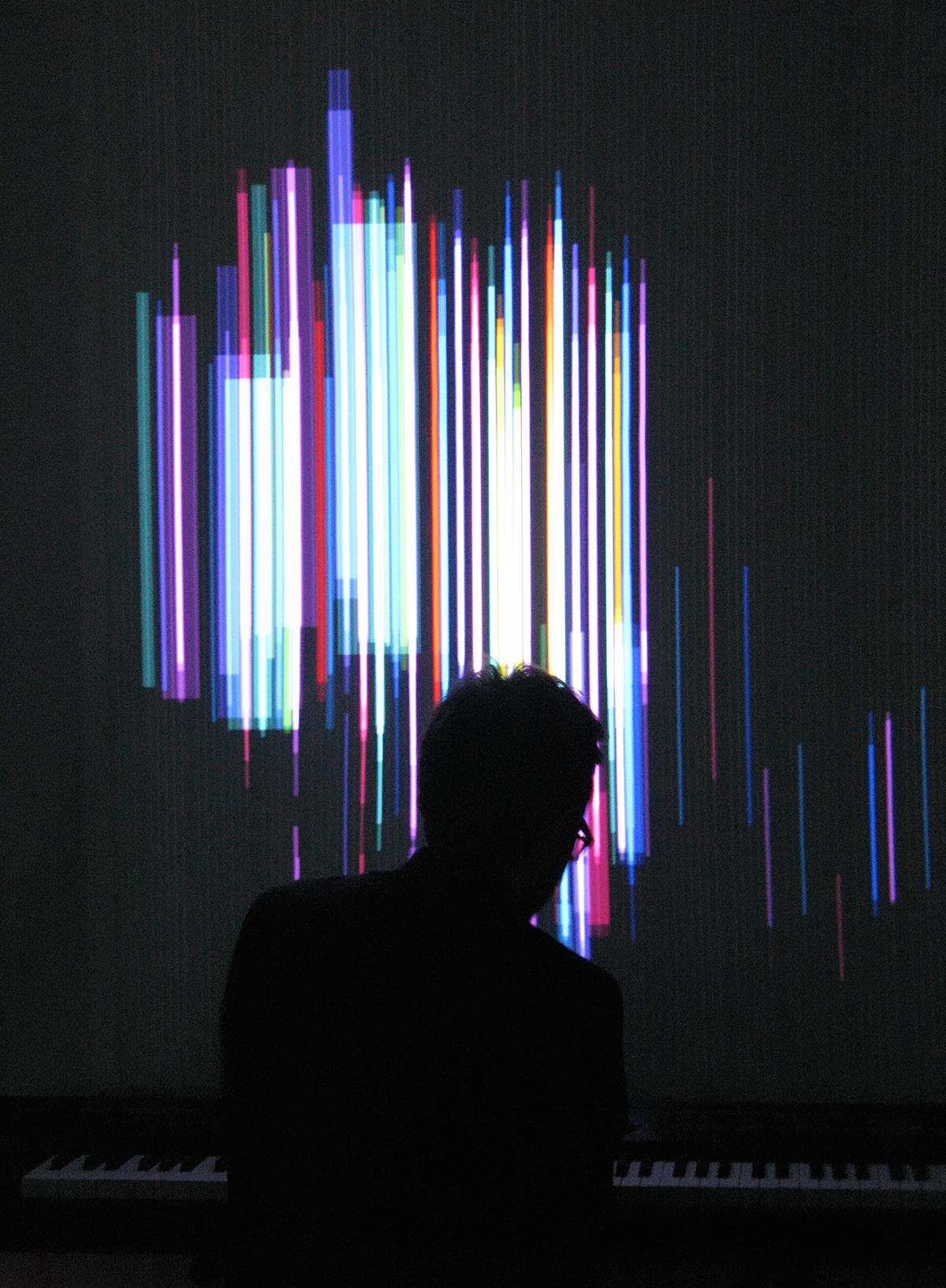
The visual concept of Clavilux 2000 is quite simple. For every note played on the keyboard a new visual element appears in form of a stripe, which follows in its dimensions, position and colour the way the particular key was stroke: The length and vertical position show the velocity, the stripe’s width reflects the length of each note.
By mapping the color wheel on the circle of fifths, the colours finally give the viewer and listener an impression of the harmonic relations. Notes belonging to one specific tonality always get colors from one specific area of the color wheel. Therefore each key gets it’s own color scheme and “wrong” notes stand out in contrasting colors. The more different tonalities a piece has, the more colorful the visualization will be.
Unlike most other visualized music, the visualization of Clavilux 2000 does not disappear when the music fades away. All stripes stay and overlap each other in an additive way, so at the end a kind of pattern remains – a summary of the music – which will be always unique. Since not only the notes played but also the interpretation of the piano player are influencing the outcome, visualizations for one single piece of music will vary, too. Therefore the stripes allow one to say something about the composition aswell as the specific performance: Which notes were played the most? Which were the loudest notes? Which range of the keys was played mostly? How harmonically constant was the music?
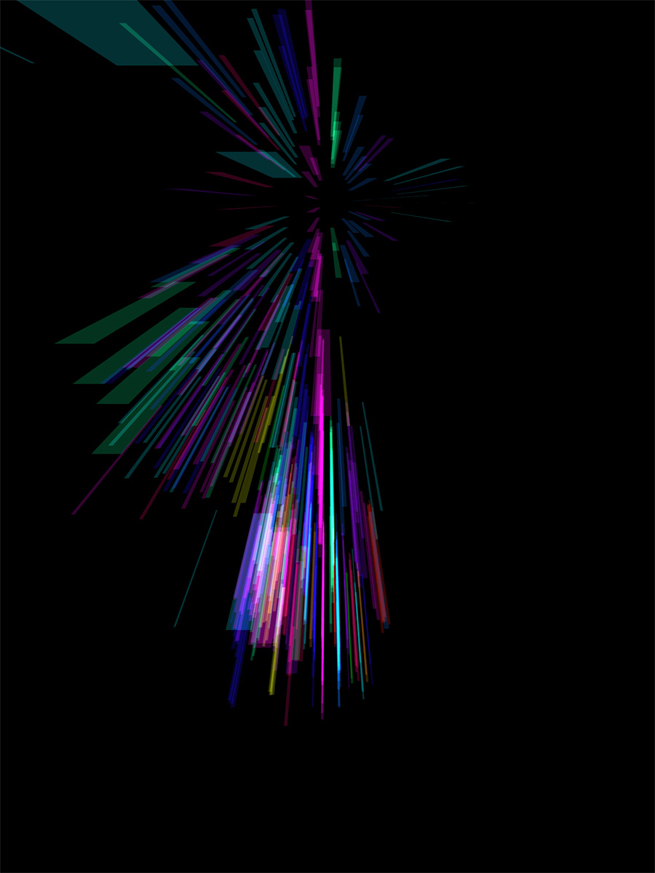
Furthermore the system allows the piano player to switch between the standart 2d view and an additional 3d view of the visualization while playing. Also the visibility of a background grid, as well as the „deepness“ of the 3d view can be adjusted with sliders on the piano.
The technical part was done with the visual programming language vvvv. The MIDI signals sent by the piano to the computer get processed in real time and directly transfered into the visualization of the Clavilux.
The Clavilux 2000 project was part of my 3rd semester at the Hochschule für Gestaltung Schwäbisch Gmünd and was supervised by Prof. Michael Götte and Veldana Sehic.


Claude Debussy’s Childrens Corner - Dr Gradus ad Parnassum (rendering)

Claude Debussy’s Childrens Corner - Dr Gradus ad Parnassum (3d view rendering)

Rimski-Korsakow’s Hummelflug (3d view rendering)
Project – Clavilux 2000
Year – 2009
Tags – HfG Schwäbisch Gmünd, interactive, Jonas's favourite, music, piano, vvvv
Hey! Ne echt schöne Arbeit. Sehr ästhetisch.
Vor allem gefällt mir euer Ansatz, dass man die Spielweise von jedem Musiker sehen kann…
Congrats!
Philipp
It looks very good and I am only wondering if it exists as an application that artists, composers and musicians could try out. I’m working with microtonal music and I would be interested to see how it is interpreted. I actually tried building such a thing in Max/MSP but it was too much processor drain…
[...] Clavilux 2000 é um piano digital que quando tocado, simultaneamente projeta uma composição visual colorida. Para cada nota, um novo elemento aparece na forma de uma linha, cuja dimensão, localização e cor correspondem a tecla e a maneira que ela foi tocada, criando uma espécie de processo sinestésico artificial. [...]
[...] interaktivt musikkvisualiseringsprosjekt gjort av Jonas Heuer i tredje semester på “Hochschule für Gestaltung Schwäbisch Gmünd”. Når ein trykker [...]
[...] Instrument zur Visualisierung von Musik – am Klavier gespielt – entwickelt. Es heißt Clavilux2000 und wurde mit vvvv programmiert. Jede gespielte Note entspricht einem Streifen in der [...]
[...] Interactive instrument for generative music visualization from Jonas Heuer. [...]
[...] Clavilux 2000 [jonasheuer.de] is a subtle music visualization installation that represents the playing of sounds by way of a simultaneous animation that can be interpreted. [...]
[...] Learn more about this fantastic tool here Jonas Friedemann Heuer – portfolio – Clavilux 2000. [...]
[...] Jonas Friedemann Heuer the creator of the installation below has developed a contraption with visualization music from an electronic keyboard: [...]
[...] CLAXILUX: UN TECLADO DE TODA LA VIDA PERO CON… ¡LUX! [...]
[...] The Clavilux 2000 is an interactive instrument for generative music visualization, which is able to generate a live visualization of any music played on a digital piano. [...]
[...] oosterbuur Jonas Friedeman Heuer komt met een bijzonder aardig project, Clavilux 2000 genaamd. Het betreft een digitaal keyboard dat [...]
[...] 2010 March 6 by Alyssa Clavilux 2000 is a subtle music visualization installation that represents the playing of sounds by way of a [...]
[...] I really like these sound/music visualizations, anything that can unify the senses through visualization seems like a good idea to me. [...]
[...] Clavilux 2000 is an interactive instrument for generative music visualization of any music played on a digital [...]
[...] Après la table musicale Noteput, voici Clavilux 2000 un instrument interactif intégrant une visualisation de la musique. Le tout est généré par le langage de programmation vvvv et l’objet se compose d’un piano de 88 touches et d’une projection verticale au-dessus du clavier. [...]
[...] on the less political, more wonderful side of technological innovation, a simply gorgeous sound visualization project from Jonas Friedemann [...]
[...] Source [...]
[...] 彼のWEBサイトにはたくさんの演奏後の写真やvvvvのパッチ(角度悪くてよくわからんのだけど)も載っていて面白い http://www.jonasheuer.de/index.php/clavilux-2000/ [...]
[...] Clavilux by Jonus Heuer. via CreativeApplications [...]
[...] For every note played on the keyboard a new visual element appears in form of a stripe, which follows in its dimensions, position and colour the way the particular key was stroke: The length and vertical position show the velocity, the stripe’s width reflects the length of each note. Furthermore the system allows the piano player to switch between the standart 2d view and an additional 3d view of the visualization while playing. Read more.. [...]
[...] For every note played on the keyboard a new visual element appears in form of a stripe, which follows in its dimensions, position and colour the way the particular key was stroke: The length and vertical position show the velocity, the stripe’s width reflects the length of each note. Furthermore the system allows the piano player to switch between the standart 2d view and an additional 3d view of the visualization while playing. Read more.. [...]
[...] For every note played on the keyboard a new visual element appears in form of a stripe, which follows in its dimensions, position and speed the way the particular key was stroke. Colours give the viewer and listener an impression of the harmonic relations: Each key has it’s own color scheme and “wrong” notes stand out in contrasting colors. All stripes stay and overlap each other in an additive way, so at the end a kind of pattern remains – a summary of the music – which will be always unique since the notes of the composition aswell as the interpretation of the piano player are influencing the outcome. Furthermore the piano player can switch between the standart 2d view and an additional 3d view of the visualization while playing. Source [...]
[...] For every note played on the keyboard a new visual element appears in form of a stripe, which follows in its dimensions, position and colour the way the particular key was stroke: The length and vertical position show the velocity, the stripe’s width reflects the length of each note. Furthermore the system allows the piano player to switch between the standart 2d view and an additional 3d view of the visualization while playing. Read more.. [...]
This post was mentioned on Twitter by EpicallyHarshed: Music Visualization - so dope: http://www.jonasheuer.de/index.php/clavilux-2000/...
[...] Ein weiteres interaktives Projekt ist der Clavilux 2000. Ein Keyboard mit dem man live grafische Visualisierung von Musik generieren kann, indem man jegliches Lied auf dem Instrument spielt. Für jede einzelne Note wird ein neues visuelles Element in Form eines Rechtecks generiert, dass in seiner Größe, Position und Geschwindigkeit abhängig davon ist, wie man die Taste spielt. Farben geben einen Eindruck der harmonischen Beziehungen, falsch gespielte Noten stechen farblich heraus. Am Ende eines Liedes sieht man eine Visualisierung, die das Lied grafisch wiedergibt, denn alle Elemente bleiben stehen und überlappen sich. Diese Visualisierung ist jedes mal einmalig, da sie abhängt von der Art und Weise wie ein Lied gespielt wird. Es gibt einen 2D und einen 3D Modus der Visualisierung. Mehr Infos dazu gibt es ebenfalls auf der Seite von Jonas. [...]
[...] Dieser Eintrag wurde auf Twitter von David Snyder, ZachariahJamesParks erwähnt. ZachariahJamesParks sagte: RT @EpicallyHarshed: Music Visualization - so dope: http://www.jonasheuer.de/index.php/clavilux-2000/ [...]
[...] Link Permalink|Comments RSS Feed - Post a comment|Trackback URL. [...]
Hi Jonas,
bin letztens schonmal über dein Twitteraccount (über den von David) bei dir hier gelandet und dachte, ich hinterlasse mal einen Kommentar.
Das Clavilux-Teil ist extrem cool =)
Grüße aus Sifi
Benny
PS: ich werd das Video bei Gelegenheit mal im Blog verlinken ^^ (falls das nicht okay ist, einfach Bescheid geben)
Hi johne, its Hagit. I dont know if u remember but I studied in Hfg last year as student exchange from Israel(Mario friend:).
anyway i saw your project and i loved it! Good luck!
Das Projekt ist sowas von geil! Also echt richtig gut! Begeistert mich selbst ein Semester später.
Falls du dich doch mal erbarmst zu antworten, ich habs nicht ausm Kopf bekommen:
Wie kannst du aus einzelnen Noten die Tonart bestimmen? Ich mein wenn du ein “C” spielst, kannst du das im Quintenzirkel doch dem C-Dur genauso zuordnen wie dem G-Dur oder nem As-Dur.
Kommt da ja jeweils vor.
Grüße =)
Mich zerfetzts, das ist total Strhansi. Wo hängt denn der Beamer, so seitlich?
Grüße
Gabi hat gerade deine Visualisierten Töne entdeckt. War schön anzuhörschauen. Genial generativ!
Hoffe Deine Arbeit und Musik machen weiterhin Spaß.
Beste Grüße auch an Joana und hoffentlich bis bald (findet da nicht in Kürze ein Kongreß für visualisierte Musik in Leipzig statt)
Dein Andreas und Gabi